explainer · 7 min read
Who invented the weekend? Saturday's short history, and how to take yours back
The 2-day weekend is about a century old. Saturday and Sunday off arrived in pieces, from a Roman law to mill towns to the 40-hour week.
By ThriveBrook editors · Updated October 2026

The word “weekend” caught on in Britain in the 1870s, and the American 40-hour week didn’t take full effect until 1940. Nobody designed the two days off. They were assembled over about 1,600 years, one piece at a time, by a Roman emperor, British craftsmen who skipped Mondays, mill workers, a New England spinning mill and a Detroit carmaker.
Your first step comes before the history. Pick a half-day this weekend, Saturday afternoon or Sunday morning, and block it on your calendar. Keep it free of chores and errands, and don’t fill it with a plan.
Sunday came first, in 321
The seven-day week is far older than any weekend. Judaism kept a continuous seven-day cycle, with the Sabbath as its day of rest, by the 6th century BC at the latest. That date comes from sociologist Eviatar Zerubavel’s history of the week, The Seven Day Circle.
The Romans counted market days in an eight-day cycle for centuries before a seven-day week named for the planets took over.
On March 7, 321, the emperor Constantine made the day of the Sun a legal day of rest. His law, preserved in the Code of Justinian, told magistrates and city dwellers to rest and ordered workshops closed. Farmers were exempt, since a good day for sowing or planting vines couldn’t always wait.
One legal day off a week then lasted more than 1,500 years. Factories brought the second day in pieces. British mills won half of it in 1850, and an American mill gave the whole of it in 1908.
| Year | Place | What changed |
|---|---|---|
| 321 | Roman Empire | Sunday rest in cities |
| 1700s | Britain | Craftsmen skip Mondays |
| 1850 | Britain | Mills stop at 2 p.m. Saturday |
| 1879 | Britain | ”Week-end” catches on |
| 1908 | New England | A mill closes 2 days |
| 1926 | Detroit | A carmaker sets 40 hours |
| 1940 | United States | Overtime after 40 hours |
Three of these rows are laws: Constantine’s, Britain’s Factory Act of 1850 and the Fair Labor Standards Act of 1938, whose 40-hour rule arrived in 1940.
Saint Monday, the day workers took
Long before any law gave them Saturday, British workers found a day off on their own. Craftsmen were usually paid on Saturday, and many simply didn’t show up on Monday. The habit was called keeping Saint Monday.
Historian E. P. Thompson traced it through the 1700s in his 1967 essay “Time, Work-Discipline, and Industrial Capitalism.” A later study by historian Douglas Reid dated its decline to the century from 1766 to 1876.
The custom was common enough that Benjamin Franklin mentioned it in his autobiography. As a young printer in London in the 1720s, he credited his steady habits for his standing at work.
My constant attendance (I never making a St. Monday) recommended me to the master; and my uncommon quickness at composing occasioned my being put upon all work of dispatch, which was generally better paid.
Saint Monday had an obvious weakness. It cost a day’s wages, and employers fought it, because a mill needed every hand on the floor when the engine started.
A half-day on Saturday
The fix came from Parliament. Its first step, the Factory Act of 1847, known as the Ten Hours Act, limited women and young people in textile mills to 10 hours a day.
The Factory Act of 1850 then fixed their hours at 6 a.m. to 6 p.m. on weekdays, or 7 to 7 in winter. On Saturday, their work had to end at 2 p.m.
Most mills couldn’t run without those workers, so the whole mill went quiet. If you’d tended a loom in a Lancashire cotton mill in 1851, your week would have ended at 2 on Saturday afternoon.
The 1850 law came at a price. It raised the legal week from 58 hours to 60, with 10.5-hour weekdays and a 7.5-hour Saturday. Each weekday grew by half an hour in return for the early finish.
We think it was a good trade, because half an hour on a Tuesday is easy to lose and a whole free afternoon is time you can plan around.
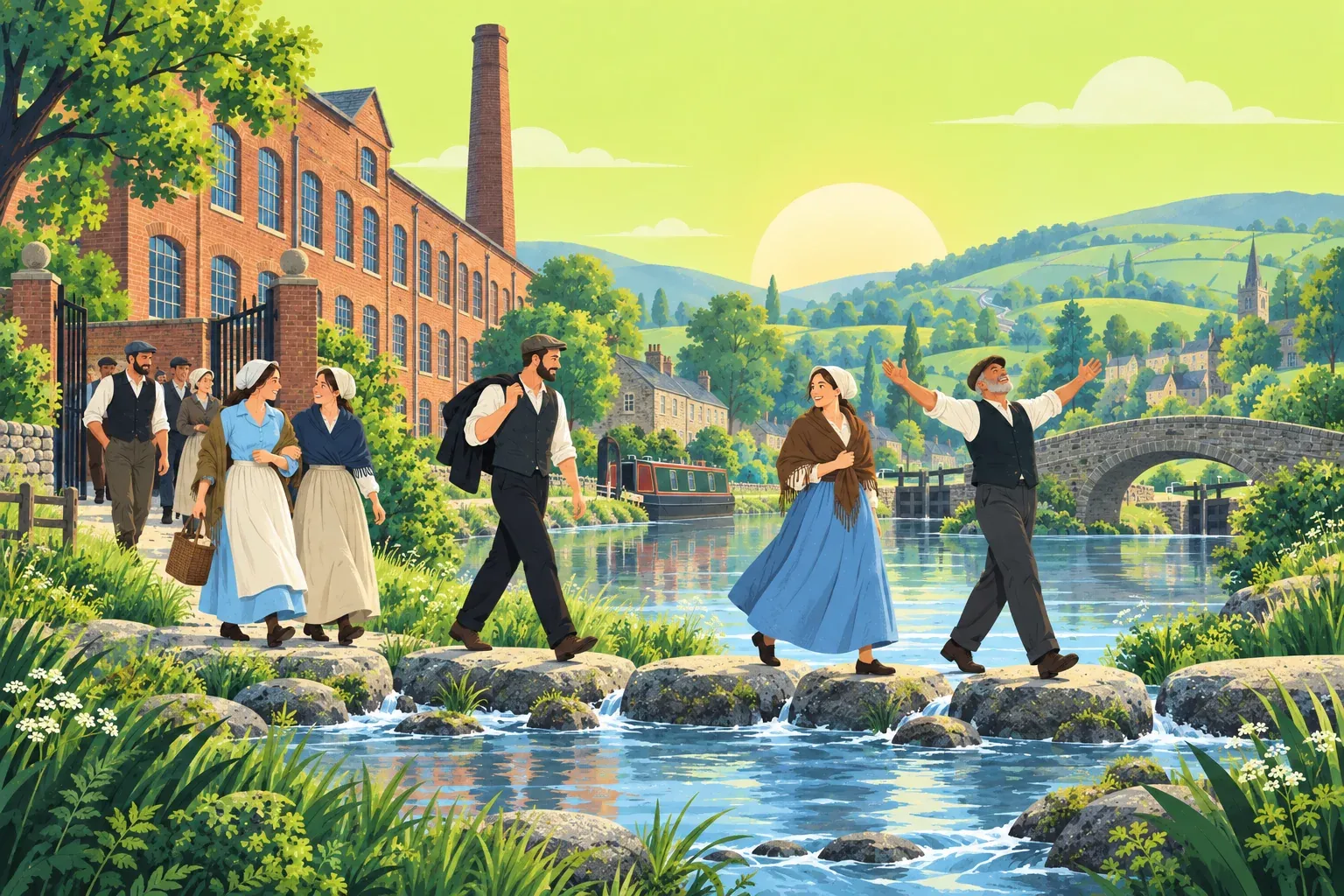 The 1850 Act covered textile mills, where women and teenagers made up much of the workforce.
Reid found that Saint Monday faded as the Saturday half-day spread through British industry after 1850. His study ends in 1876, by which point the legal Saturday afternoon had largely replaced the old Monday habit.
Where the word “weekend” came from
The word took hold about when the habit did, though its roots go back further. The Oxford English Dictionary’s oldest example, from a 1638 Yorkshire record, means only the end of the week, when poor weavers had to sell their cloth. A clergyman named William Bagshaw Stevens used it in his journal in 1793 for a trip he planned to take.
An 1870 issue of the Food Journal defined it as the stretch “from Saturday until Monday” and called it “the season of dissipation”.
Most popular histories, Bill Bryson’s book At Home among them, start with a line from 1879. That year a writer in Notes and Queries, a London magazine for readers’ questions, explained a Staffordshire saying. If you left home after work on Saturday afternoon to spend Saturday evening and Sunday with friends some distance away, people said you were spending your week-end there.
The Staffordshire version is still the one worth remembering. It describes a weekend as time away from the work week, spent with other people.
America’s first 5-day weeks
America’s first two-day weekend came from religion.
In his 1991 book Waiting for the Weekend, architect and writer Witold Rybczynski names the first factory to adopt a five-day week as a New England spinning mill, in 1908. Many of its workers were Jewish and kept a Saturday Sabbath. The mill closed on Saturday for them and on Sunday for everyone else.
It came at the end of a long slide in factory hours. Economist Robert Whaples, writing for the Economic History Association, drew the numbers from an 1883 federal report and later manufacturing censuses.
Those sources put the average factory week at 69.1 hours in 1830. It was still 59.6 hours in 1900 and 50.6 in 1929.
With the week near 50 hours, Whaples writes, the push in the 1920s turned to Saturday, especially in industries where most workers were Jewish. Only 32 large establishments had a five-day week by 1920. By 1927, at least 262 did.
The biggest was a Detroit carmaker, which put its factory workers on five 8-hour days, a 40-hour week, in 1926. Whaples writes that it employed more than half of the nation’s approximately 400,000 workers with five-day weeks.
Overtime pay and the 40-hour week
President Franklin Roosevelt signed the Fair Labor Standards Act on June 25, 1938, and it took effect that October 24, according to a history by Labor Department historian Jonathan Grossman.
The law didn’t ban long weeks, but it required pay at one and a half times the regular rate for hours past a ceiling in the industries it covered. The ceiling was 44 hours in the first year and 42 in the second, then 40 hours from October 24, 1940.
Nothing in the act gives anyone Saturday off. Instead, the law makes a sixth day cost the employer 50% more per hour.
With 8-hour days, 40 hours fills five of them. That overtime cost, more than any custom, helps keep most American Saturdays free.
Farm workers were left out of the law from the start, and many nurses, cooks and store clerks still take their days off midweek.
Claim your Saturday
Go back to the half-day you blocked. If you need a start time, use 2 p.m. on Saturday, the hour the 1850 Act set for mill workers to stop. If your weekend falls midweek, take the same block on your first day off.
The mill workers of 1850 paid for their afternoon with half an hour on every weekday. Your price is smaller, a few chores done before the weekend starts.
Move the grocery order to Thursday night and the laundry to a weeknight. Then tell anyone who might fill those hours that they’re taken.