faq · 8 min read
How to start decluttering: 1 drawer, 15 minutes, and 8 answers on what to keep
Begin small, decide where the giveaway bag goes first, and learn what to do with old clothes, dead batteries and leftover paint.
By ThriveBrook editors · Updated October 2026
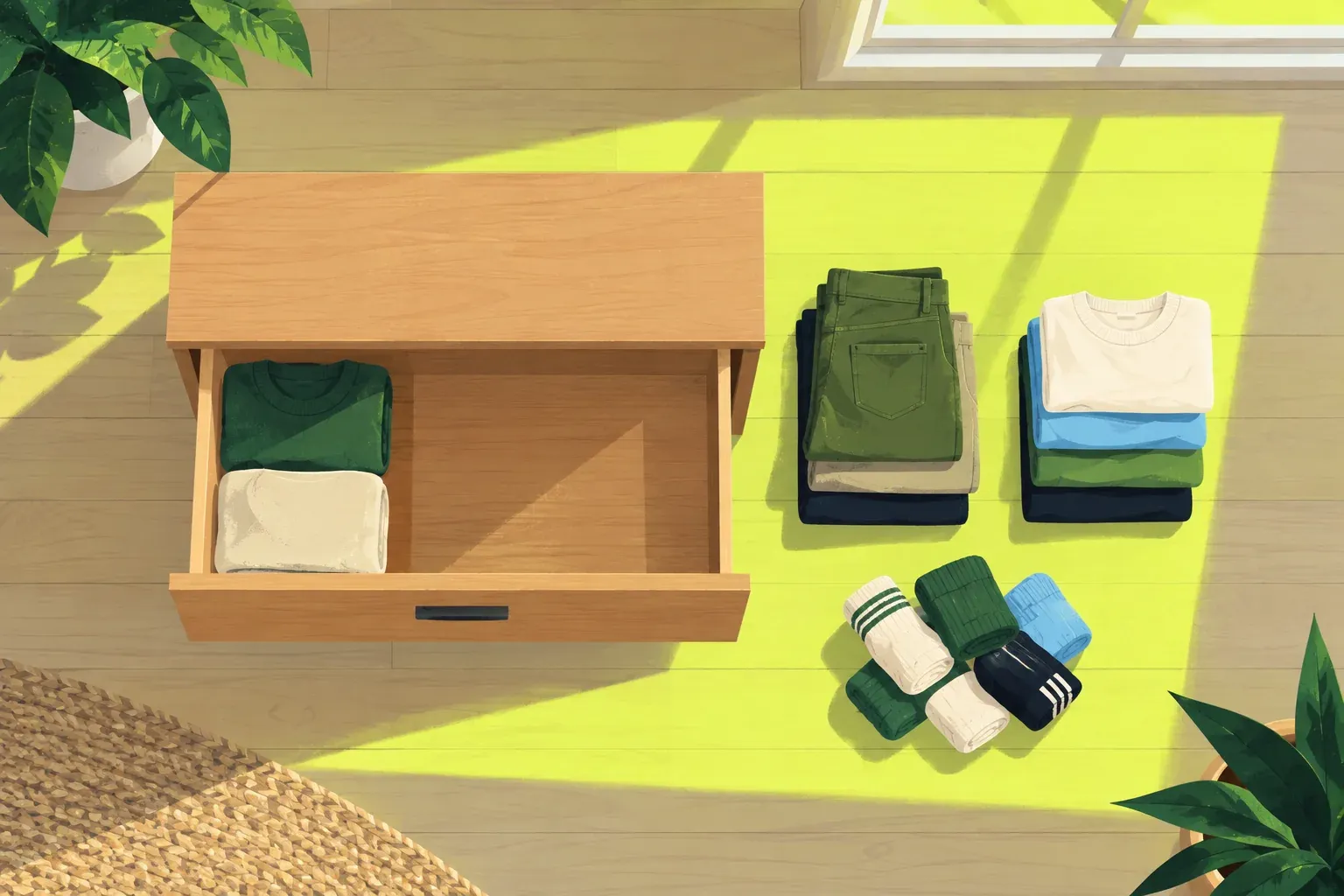
The garage is the worst place to start decluttering. It holds the heaviest, oldest and most tangled decisions in the house, and a Saturday out there tends to end with half of it on the driveway and no plan for any of it.
Start with one drawer instead. This weekend, set a 15-minute timer, empty a single drawer onto the bed and sort everything into three piles: keep, donate and toss. Before the timer starts, decide where the donate pile will go, and set a bag for it by the front door.
Where should I start?
Start with a small space you use every day that holds few memories, such as a junk drawer, the bathroom cabinet or a sock drawer. You’ll see the result every time you open it, and nothing in it will stop you cold.
Save the photo boxes and the garage for later, once you’ve practiced on things that don’t matter much.
When the timer rings, stop, even if the drawer isn’t done. Put the keep pile back first, take the trash out the same day and carry the donate bag straight to your car.
How do I decide what to keep?
Ask three questions of each item, in order, and stop at the first no. Have you used it in the last 12 months? Would you buy it again today? Do you have a place for it, one drawer or shelf where it lives? An item that clears all three goes back in. One that fails any of them goes in the out pile, which you then split into donate and toss.
Two kinds of things skip the test. Keep safety gear you hope never to use, like a fire extinguisher or a first-aid kit, and any records you’re required to hold onto.
If you stall on an item for more than a few seconds, put it in a maybe box. Tape it shut, write a date six months out on the lid and donate the box unopened if that date passes and you never went looking for anything inside.
What about sentimental items?
Leave them for last, after the easy drawers have given you some practice. Then cap the space, one box or one shelf per person in the house, and let the box decide how much stays.
Inside that box, keep the best example of each kind of thing. One drawing from each school year tells the story as well as a stack of 40. For bulky keepsakes, such as a trophy, a wedding dress or a full set of baby clothes, take a photo before you let the object go, and give relatives first pick of any family pieces you no longer want.

Ask a grown child before you give away the trophies and yearbooks they left in your basement, since those calls are theirs to make.
Where can I donate or recycle what I don’t keep?
Clothes and shoes in good shape go to a charity drop-off or a thrift store, and most other things have a better home than the trash. The Environmental Protection Agency estimates Americans generated 17 million tons of textile waste in 2018.
Of that total, 11.3 million tons went to landfills and 3.2 million tons were burned in combustion facilities. Only 2.5 million tons were recycled.
For clothing and footwear alone, the agency put the recycling rate at 13%. Worn-out pieces, like stained shirts and single socks, can go in a textile recycling bin if your town runs one. Your local solid waste office can tell you where the nearest one is.
Donations can cut your taxes, with two limits. IRS Publication 526 says you can’t deduct clothing or household items unless they’re in “good used condition or better”, and you have to itemize deductions to claim any gift. Write down what you gave and when.
Electronics, batteries and paint can’t go in a donation bag or the curbside bin, so plan a second stop for them. The table shows where each kind of item goes.
| Item | Where it goes | Before you drop it off |
|---|---|---|
| Clothes and shoes in good shape | Charity drop-off or thrift store | Wash them, and list them if you itemize |
| Worn-out textiles | Textile recycling bin, where your town has one | Bag them dry |
| Phones, laptops, tablets | Electronics recycler or donation program | Delete all personal information |
| Lithium-ion batteries | Battery drop-off or hazardous waste site | Keep them out of trash and recycling bins |
| Leftover house paint | Paint drop-off site in a stewardship state, or hazardous waste collection | Original can, 5 gallons or smaller, label on |
| Cleaners, pesticides, motor oil | Household hazardous waste collection | Original containers, never mixed |
The EPA says lithium-ion batteries, and devices that contain them, should not go in household garbage or recycling bins. That covers old phones, laptops, cordless tools and most rechargeable gadgets in a junk drawer.
Paint is simplest if you live in one of the 12 states with a paint stewardship law, or in Washington, D.C. That group includes California, New York and Oregon. There, a program run on behalf of paint makers takes latex and oil-based paint at no extra cost at its drop-off sites, as long as the can is the original one, holds 5 gallons or less and still has its label. Everywhere else, your county’s household hazardous waste collection takes paint along with old cleaners and pesticides.
Is it OK to sell things?
Yes, and for furniture, tools and electronics in good shape it’s often worth the effort. Give each listing a deadline of about two weeks, then donate whatever hasn’t sold so the pile doesn’t turn into a new kind of clutter.
Taxes rarely come into it. The IRS says a loss on the sale of a personal item can’t be deducted, and most used things sell for less than you paid. A gain, such as a collectible that rose in value, is taxable income.
Payment apps and online marketplaces send a Form 1099-K only when your sales top $20,000 in more than 200 transactions, though a gain below that line is still taxable. The IRS page on what to do with a Form 1099-K explains how to report a sale that lost money.
What if my partner won’t declutter?
Start with your own things and leave theirs alone. Clearing your side of the closet and your desk changes the room without an argument.
For shared spaces, agree on one small zone at a time, like the hall closet or the kitchen counter, and sort it together for 15 minutes. Never give away a partner’s belongings without asking, even something that looks like junk to you.
Sometimes the problem is bigger than a full closet. The American Psychiatric Association describes hoarding disorder as persistent difficulty parting with possessions because of a perceived need to save them, and it has been a diagnosis of its own since 2013. If that sounds like your partner, a parent or you, talk to a doctor or a mental health professional before anyone starts hauling bags out.
How long should it take?
Plan on one 15-minute session for a drawer or a shelf and several for a closet or a kitchen. A whole house can take months at that pace, and that’s fine.
Order matters more than speed. Work from drawers and shelves to closets, then whole rooms, then the garage, attic and basement, with sentimental items last. Write that list on paper and cross off each space as you finish it.
How do I keep clutter from coming back?
Give every new thing a place before it comes in, and if it has none, something else has to go. This one-in, one-out habit works best on the categories that grow without anyone noticing, such as mugs, T-shirts, tote bags and phone chargers.
Keep a donate bag in a closet all the time. When something stops earning its spot, it goes in the bag that day, and a full bag goes to the car.
Recycle junk mail and takeout menus at the front door, before they reach a counter.
Your one drawer
Only three kinds of things go back in: what you’ve used in the past year, what you’d buy again today and what has a spot in that drawer. Everything else leaves in the donate bag or the trash.
Stop after one drawer, even if you feel like doing a second. If the drawer isn’t finished, leave the rest for next weekend and walk away when the timer goes off.